|
Ecological-Studios:
First
steps in a users primer for reconstructing the recording studio's
around green design
and architectural practice
|
III)
Box: The Real World , an eco-recording studio exemplar in
the making
In the
tiny Wiltshire village of Box nestles Peter Gabriel's Real
World/Womad complex. The buildings are a watershed experiment
in the fusion of elements of green design practise with
the musical world of recording studios and rehearsal facilities
and other electronic media studios. It does not however
utilise renewable energy and it's a dream made possible
by someone who's made considerable money, which the average
group of people wouldn't have to develop a small or medium
sized financially affordable studio.
Peter
Gabriel's Box project is arguably the furthest step any
established 'star' has committed themselves to the green
dimension of recording practise. Indeed it is a perhaps
- so far - unique project in the music world, particularly
the popular music world. The architects are the Frielden
Clegg Bradley who started out down the road from Box, in
Bath. Fielden Clegg Bradley are big names in green architectural
practises, one of the first to consider seriously the green
design dimension. They have been involved in numerous ecologically
orientated building projects for the last twenty years or
longer. Their latest work includes the Doncaster based Earthcentre
as well as many higher educational buildings..
|

The
Wooden Room, RealWorld Studios. Photo: Simon Doling
|
When I asked
Peter Clegg of the practise to what extent the studios at Box
were built to ecological specifications, and what were those specifications,
Clegg replied that there wasn't an ecological brief as such, but
that Gabriel and his colleagues and Fielden Clegg Bradley had
a 'vague desire to do things properly'. Later in the conversation,
he mentioned that to some extent it was the architectural practise
leading the design, although at the same time Gabriel was coming
up with ideas which fed into leading the building process.
Clegg lists
four fields which he believes are crucial to the ecological elements
at the Box studios. The first three echo the fields described
earlier: Energy use, Material issues, and the internal health
of the building. Fourth, though not least is the general feeling
of the buildings, the 'ambience' as he calls it.
Energy, as
has already been stated, is the obvious player in sustainable
architecture. Whilst there were various attempts to cut down fossil
fuel consumption, Clegg says he feels 'a bit guilty' that he didn't
consider this more seriously. The two parties could have done
a more detailed analysis of energy consumption, but didn't. Later
in the conversation he talks of the enormous savings that can
be made by low energy flourescent lighting, a revolution that
is reducing the energy running cost in domestic equipment. If
the same technology could be applied to such studio equipment
as the mixing desk, you could begin comparable revolution. It
could happen, says Clegg, 'if the desire was there'.
The materials
issue comes down as quite ambivalent, and might not resonate with
deeper and more purist Greens. For the old Mill building at Box,
the primary studio, the materials of the existing buildings or
at least the stone/brick infill shell of the seventeenth through
twentieth century husk was left as before. The new materials that
were introduced were kept in as natural a state as possible. The
floors for instance were second-hand oak wood. Steel, which Clegg
included as a natural material (but which many in the Green design
field wouldn't) as 'it didn't pretend to be anything else', was
used for the wallways. In the new control room building there
was a concrete frame, steel again, and quere cork - as well as
lead, with an oxidised coating, which actually, he said, prevents
further degradation on the control rooms walls and roof.
The third section, the internal health of the buildings centred
on the pollutants in the air of the air conditioning. Also internal
materials were usually as natural as possible, such as timber
rather than formaldyhyde panels - where, as he mentioned, the
latter can have an adverse effect on some people.
In fact Gabriel
had said that he felt ill and nauseaus in many of the recording
studio's he'd been in. And although he had no proof, Gabriel's
intuition was that it was the air conditioning, and the actual
materials of the duct work of the air conditioning, particularly
the negative ions. So as part of the brief there was an attempt
by Fielden Clegg to use timber and clay, hardly the conventional
materials, for the air conditioning, generated by Gabriel's request.
Vitrified clay ducts were therefore used in the studio, timber
glulam ducts in the workroom, and sheet metal ductwork only where
they were concealed from view. In all, the studio, stone room,
workroom and mixing room were air-conditioned, whilst natural
ventilation was adopted for non-acoustically sensitive parts of
the buildings. Indeed it's acknowledged that air conditioning
exacerbates problems of Sick Building Syndrome.
The last issue
that the brief dealt with was the ambience. Plastic was reduced
as much as possible as it was divorced from the experience of
the outside world, and as much natural light was brought into
the building as possible without affecting the balance of the
air conditioning. This is unusual as most studio's are buildings
within buildings designed without any connection with natural
light. It is a difficult strategy to take, because of the effect
on air conditioning, but at Box north-facing windows were built
in, looking out at the Mill, and providing a real connection with
the outside world. As part of this re-integrating the water of
the ByBrook tributory and the watermill into the site, added significantly
to the aesthetics of the design, including the various qualities
associated with water to the whole experience of the place, if
not the practical application of a working watermill.
There's also
the small timber-framed writing room which has proved popular
with musicians. It isn't air-conditioned though, nor sound sealed
from the outside. There were other problems, namely that it was
a few yards from the main London to Bristol railway line (not
named Box for nothing) and when 125 trains were passing, heading
up Box hill, both engines in use, the silence was deafening. Musicians
had tried to get round this by playing in between the trains;
in fact Nigel Kennedy once timed his quartet to play movements
lasting just short of the interval between trains.
I asked Clegg
about the use of local materials, such as Cotswold stone, or whether
woods particular to the immediate environs had been used. Regionalism
wasn't really part of the equation, he said. It wasn't a matter
of conservation of style either, and the conservation of materials.
This wasn't part of the practise's remit. They were quite happy
to import cheap timber from Canada, when global material is 'stunningly'
cheap, and local materials excessively expensive. Almost all the
architectural world, including the vast majority of ecologically
motivated architecture and design wouldn't be anywhere without
the modern technology upon which global transport is predicated,
Clegg claimed. Tell this to the Permaculturists, I thought, but
sympathised with the pragmatics of the example Clegg provided,
the ubiquitous silicon in double-glazing. Which is of course a
key method of reducing building energy usage. Still it was peculiar
that a practise that claimed to have designed and built the lowest-energy
buildings, and had been completely within the domestic market
prior to Box, hadn't considered the energy remit of Box with a
forward-thinking seriousness, and also didn't give the other hidden
costs of the great global transport jamboree much attention, and
consider the virtues of the region even a possibility. The Gabriel
people had talked about and possibly began to study the feasibility
of solar and turbine power - turbine particularly as much of the
studio is in the river sited Mill. But it was too expensive to
install £30,000 turbines which would need regular cleaning
and maintenance, so as a project it had gone by the wayside. As
it is, the electrical supply is generated from a 300kVA substation
at the grounds edge, supplying a main distibution board which
in turn supplies lighting, small power and mechanical services
control panel as well as offices, accomodation and store areas.
I continue to wonder if there isn't any feasibile possibility
for Box to inaugorate and integrate a small field of Solar panels
or Photo-Voltaic Cells to help with the energy required. As it
was one of the studio manager's at Box said the electricity bill
there was 'phenomenally expensive'.
The acoustics
element was the primary engineering and design problem set by
Box. Various proposals were advanced to control the airborne and
structure-borne sound, both from and to the studio complex in
relation to the outside; acoustically suspended floors and walls,
triple glazing, and silencing of inlet and exhaust ducts. As a
result the main studio's floor and mixing room was designed to
include a secondary floor independent of the main structure, comprised
from a 200 mm reinforced concrete slab sitting on rubber anti-vibration
mountings. This doesn't sound, with concrete and rubber, purely
green, and it may well be that acoustics will be a central stumbling
block which green design would have to get its teeth around were
it to take up the idea of Eco-Studio's.
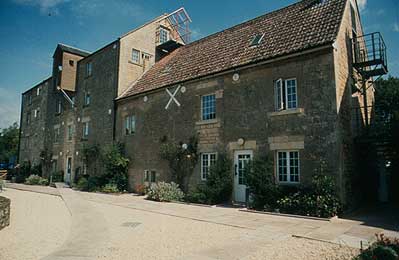 Real
World Studio. Photo: Stephen Lovell-Davis Real
World Studio. Photo: Stephen Lovell-Davis
After Box
Fielden Clegg did some work for Dave Stewart of the Eurythmics
in the south of France, and one of Box's studio engineers did
some consultancy, but essentially the notion of major league studios
organised around elements of green design principles remains stalled.
Box remains in a category of its own, a signal beacon of a step
along the way of how the world of recording could complete the
surrounding natural world rather than exist completely alienated
from it. What's needed is the proliferation of the materials so
that it is accessible to the individual and small scale studio
builder - without a formidable international recording career
behind him. If a few record companies or 'star' bands could literally
build upon and extend the notion of Box with a green dimension
the beginnings of the green recording studio would be here to
stay. However placing the Real World studios in a comparatively
rural setting seems to be a radical gesture, because it demonstrates
how hi-tech music and media worlds can thrive at some distance
from the city, and in so doing sets up new futures for the country.
next
|

