|
Sound for
airports: Washdown time in the departure lounge.
In Oslo's
glittering new Gardermoen airport, Anna Karin Rynander's sound
sculpture installations merge with the needs of travellers, offering
an aural washdown, for the tired and weary. These 'Sound-Showers'
also suggest a routeway into reimagining sustainable transport
for both new media art and soundscaping communities.
by Oliver
Lowenstein fourthdoor@pavilion.co.uk
- 01273 473501
For the first-time
arrivee, Oslo's Gardermoen airport is an overwhelming experience.
Initial surprise as you peer out of the plane's windows at the
long gantry of lit-up glass-cased buildings, is overtaken by astonishment
once you find yourself inside. The swish escalators, and monumental
concrete pillars; the central atrium with its high, high ceiling,
and the hi-tech information screens, all give off an impression
of Nordic public building modernism, updated for the twenty-first
century. What is particularly noticeable though, (and such a contrast
to the ramshackle updatings of British airports) is the ubiquitous
use of wood; from the massive girders, and office wall cladding,
to the floor. The airport has been one of Europe's largest building
projects of the nineties, yet it remains hardly known outside
Scandinavia. To complement an entirely new building complex, the
airport instigated a public art programme. Of the various differing
pieces from sculpture, to the multi-coloured fabric piece reaching
up into the central concourse's roof, the most commented upon
pieces are the new media installations, known as 'Sound-Showers'.
 Picture
coutesy of Anna Karin Rynander Picture
coutesy of Anna Karin Rynander
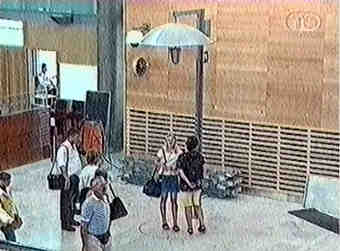
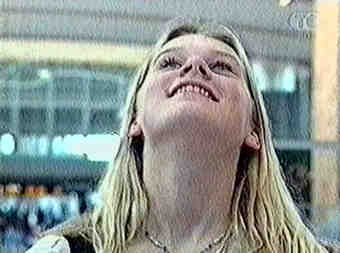
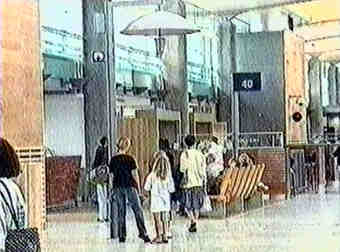
Sited unobtrusively
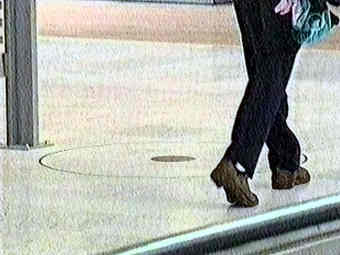
round different parts of the airport, the Sound-Showers sit waiting
for people to enter their 'focus centres'. Thereupon the person
triggers sensors which start up the installation, and as they
stand there, the wash-down from quiet, slightly eery, whispering
voices begins. Stand under the shower, and soft, intimate voices
begin to massage you: "The future is sound", followed disquietingly
by "The machine is my friend" and a few moments later a phonetic
"uh uh uh uh...", ripples inside the head. Inside, the showers
are a slightly disconcerting experience, hearing the voices as
if from inside your cranium.
These very
intimate voicesounds range from whispered voices to babies, in
both English and Norwegian. The intimacy contrasts poignantly
with the authority of the terminal's flight departure and arrivals
announcer. Any of the 2 million people who use the airport annually
could take a Sound-Shower, and although it's a very direct experience
for the public, it does not disturb the rest of the airport. The
Sound-Showers' existence in the downtime space of a building is
a surprise: another world inside the sound of airports.
 Picture
coutesy of Anna Karin Rynander Picture
coutesy of Anna Karin Rynander
Sound-Showers
are the creation of the Swedish born sound-artist, Anna Karin
Rynander, who in the last ten years, has engaged in a variety
of intriguing sound based artworks which have been explicitly
related to the different forms of travel, mainly in Norway, where
she spent her student days.
These works,
part way between installation, new media and public art, also
contribute to the well being of the passing traveller and are
part of the small, though expanding, activity of artists testing
public spaces, and specifically transit spaces, as an arena for
experimentation. Together they convey one of the principle concerns
of the new media artist; exploring the new spatialities engendered
by the technology. Explorations, no doubt, inspired by many an
art college new-media course. And at Gardermoen, Rynander's Sound-Showers
feel like a foretaste of how new media might be integrated into
a possible future transport infrastructure. An airport, however
attractive its design, is perhaps not an obvious place to go looking
for the beginnings of an aesthetic that fuses new media with acoustic
ecology: a hybridising which could encourage a different sensibility
towards travelling, indeed, be supportive of sustainable and ecologically-aware
travel. But Sound-Showers are in no way restricted to use only
in airport lounges, they could form a representative part of a
new media repertoire underscoring a futuristic sustainable transport
agenda; one which not only seeks to change travelling patterns,
but is also sensitive to, and aiming to transform, the present
day aural environment.
For if the
present day outdoors acoustic environment is considered, it has
been the sound transformations which have occurred around travel
which are, by definition, the most far reaching. Today, the most
ubiquitous outside sound is that of car wheels on tarmac. This
is quickly followed by other vehicles, and next by the soundworlds
which emanate from trains and airplanes. Indeed the automobile
engine has been blamed for submerging a whole strata of soundworlds
from the natural world, which humans have been aurally interacting
with for thousands of years, (until very recent times). Anecdotally,
people state that in Britain today, because of the extensiveness
of the road network, there are very few places to be found in
the natural world where people can hear birdsong, without the
interfering sound backdrop of road vehicles.
Is this an
argument for different modes of travelling? That is, are there
forms of travelling which are more sensitive to preserving and
remaking convivial sound ecologies around us?
Given that
sound artists are one of the few constituencies who might be attuned
by temperament and profession, to inspire the rest of us to change
our perceptions of how we relate to our surrounding aural environment,
they might well be tempted to draw wider communities into an awareness
of experiencing - the wider, wilder soundworlds which we inhabit.
 Picture
coutesy of Anna Karin Rynander Picture
coutesy of Anna Karin Rynander
In the larger
frame, sound artists make-up an intriguing if disjointed alliance
with the convergent territory of new media. Sound is part of the
digital palette which new media artists play with, and use as
part of their repertoire. And new media - which is also about
communication between places, if not the physical journeying between
them - is increasingly part of the repertoire of public space
art, of which a particular and increasingly popular variant is
focussed around travelling and transit spaces. New media and sound
artists aren't, on the whole, interested in sustainability issues.
They are, after all, artists. But for those inspired by acoustic
ecology and soundscapes, placing environmental transport in the
equation is one way, of at the very least, thinking about the
real world connection between one aspect of the sound environment
and our mode of travel.
Even if there
is not a profusion of examples of how this synergy might evolve,
a few examples are beginning to surface internationally where
new media artists, using the different media at their disposal,
are experimenting in new media art specifically for the travelling
public. It seems to me that if this was pursued further, it could
be possible to develop a completely transformed travelling culture,
of delight. New media installation can potentially be applied
to any context, including transport infrastructures; be it cycle
networks, walkways, bus transit routes, or the energy-eating car
culture. If one dreams of significantly fewer cars on the road,
rather than the actual reality of increasing numbers, the alternative
travel infrastructure needs to be as psychologically attractive
as possible, a counter-move to the addictive quality of the automobile.
Sound artists could be amongst those to address this dynamic possibility.
One part of a contingent end-game could even be a 'resurfacing'
of the soundworlds long drowned-out by the world of roads and
the machines which ride them.
 Picture
coutesy of Anna Karin Rynander Picture
coutesy of Anna Karin Rynander
Anna Karin
Rynander is among this new hybrid of new media artists, whose
work also falls tangentially, though she would say incidentally,
within the pale of sound ecology and environmental issues. She
has been fortunate in utilising a specific highly visible transit
site - Oslo's new Gardermoen airport. 'I think that these specific
Sound-Showers are made for Gardemoen', states Rynander. 'To take
a sound-shower is to experience the whole setting; this magnificent
airport, in many ways, with a lot of big glass walls, which allow
you to see both the Norwegian countryside and the airplanes, while
you yourself walk into the focus-circle and listen to soft whispering
voices. What you see and what's in your thoughts at the time,
influence how you experience the sound. And of course there is
a contrast between the soft sound and the powerful airplanes you
can see through the glass in the piers. But the sound in the piers
is quite soft and low, the sound from the airplanes doesn't reach
you. But with the imagination, reminiscences of the sound can
reach you, you see the airplanes. So there is a contrast.'
This isn't,
of course to say that either Gardermoen or air travel is part
of the sustainable travel remit, or that Rynander is particularly
interested in the slant with which I have infused the possible
application of new media: a futuristic sustainable travel scenario.But
Rynander's work enables the mind to muse on such applications
in a variety of scenarios.
Rynander,
and co-artist and engineer Per-Olof Sandberg, with whom she worked
on the technical side of the project, have been contacted about
further development of the concept: 'As they are, the ISRS's -
the technical software - are customised for Gardermoen. In other
places they'd need redesign, re-engineering and new sounds. The
main success factor was teamwork. I can imagine a Sound-Shower
factory where the Sound-Showers' basic concept is adapted and
integrated with different locations and environments'. These could
include, Rynander readily accepts, designs for both different
transit, and built environments, as well as "softer", contexts,
which could be around ecodesign principles, '...if it was required,
and if it's the right place for ecodesign, though it does need
to follow the basic technical requirements of the Sound-Shower
concept.'
Prior to her
becoming involved in Gardermoen, Rynander had carried out several
other new media art experiments which tangentially dovetail into
the transport frame, including "Traffic Zone" and "Birdmachines".
Of these, the latter light-heartedly utilised sensor technology
to release bird song, at a busy Oslo crossroads, when the lights
were red. Waiting car-drivers and passengers were suddenly serenaded
by singing birds; surprised people looked around trying to figure
out where the birds were, before realising the joke. From a certain
acoustic ecological perspective, such a new media piece highlights
our distance from the natural world - and from birdsong - that
it needs to be piped to the travelling perspective, even if it
shows with playful ingenuity how sensor-based new media can be
placed within the traffic-flow infrastructure. It could well be
read as a critique of noise pollution and of traffic's destruction
of the older pre-motor vehicle acoustic ecology, or indeed, the
severance of the "on-the-move" culture from the natural world.
Or it can be seen as bringing (or exploring) the aural ecology
of the natural worlds closer to the noise ecology of the motorised
world. Rynander, however, isn't particularly interested in such
apprehensions of the piece, but goes along with the notion that
there has been, and is, a continuing deterioration of the soundscape/acoustic
ecology environment. 'I think it is likely to change for the worse.
It's becoming easier to send out messages and sound from which
someone can make money. On the other hand maybe some new technology
can lower the noise-levels of cars, trains, airplanes, computers,
machines etc. Let's hope man finds out that messages are better
read in silence than together with noise, so, money could work
for silence. Silence should be offered too.'
In response
to the point that another layer is being added to the acoustic
environment and the work might be, in effect, to get rid of, or
balance the first layer, for example; traffic sounds, rather than
simply adding a new layer to enhance the mess the first layer
has made, Rynander concedes: 'That's a point. If it was possible
to get rid of the first layer, that would be an interesting idea.
Silence is good. But I also think that by adding sound it could
make you hear exciting things in noise.'
For Rynander,
the interesting thing about the "Birdmachines" was how they were
integrated into the whole traffic-system and became a part of
it - both visually and technically. 'When the traffic stopped
for the red lights, the birds started to sing like machines. The
people in the cars reacted by opening windows and smiling at each
other. As a distant viewer of this installation you could see
how it made the mechanism of the traffic-crossing more visible
and emphasised the traffic machinery; the phenomenon of a mass
of cars arriving, stopping, waiting, starting, and leaving again
in a continuous stream. The whole traffic-cross became scenography
to the art installation. I liked that.'
The last of
the three pieces, "Traffic Zone", connects to each of the others,
in that it appears to be the inverse of the proto-Sound-Showers,
yet also counterparting "Birdmachines". Rather than refreshing
people in a stressful built environment ‡ la Sound-Showers, "Traffic
Zone" introduced stress and unease; traffic sound recorded alongside
a highway, and drawn moving along an infinite line via a designed
computer programme - into a gallery context which initially had
a relaxed feel.
'Although
it isn't the main thing when you entered the circle you were surrounded
by sound, you stepped into the mass of sound, the sound-sculpture.
By stepping into the circle you changed the place, and the place
changed back again when you stepped out of the circle. Inside
the circle, the sound moved around you in an infinite-eight-formation.
Outside the circle, if somebody else was inside the circle, it
was just noise with no direction. It also felt as if it was a
very authoritative installation. Something about power. The noise
ruled the place, and the visitor could trigger it. And I also
think silence was an important part of the installation. The two
different materials and states. Although in a way it did critique
noise pollution, it was also about the naughty child who wants
to make noise; the joy when people tested out the thing'.
All three
of these pieces, though most visibly Sound-Showers, (particularly
to seasoned Northern travellers) integrate a way of interfacing
sensor-based sound media with travel. They also point to how sound
itself travels via the conduit of new media. New media means new
spatialities. It also means the uncovering of hitherto impossible
places. Given the Internet, possible real-time sound-links between
one place and another, "remote soundshowers", as it were, are
entirely feasible. Rynander observes, 'Yes, I have thought of
that. It could work. If you can add something interesting by doing
so.' This would suggest there are contexts where this could work
and where it couldn't: Are there wrong sounds for right places,
and right sounds for wrong places? It depends on what you want.
If you want a relaxing experience and you put sound x into context
y and the experience isn't relaxing - It doesn't work. If you
put sound x into context z it could work. It's like colour. One
sound could work differently in different contexts. I believe
in testing. You may get something else'.
In a world
where the cultural economy of noise is increasing exponentially,
this planet is ever louder at the end of every day. Could it be
that the chatter of machine-babble will become unbearable as the
volume surpasses certain human limits? Already with daily noise
pollution at fever pitch, any relationship with silence comes
across as irrelevant. It seems that for many, particularly highly
urbanised populations, the return to natural sound is all but
impossible. In such a context, any way forward shall, even if
by default, fall to sound designers, so that the built environment
will become an opportunity for tinting and high-lighting new,
probably unnatural soundworlds. The now submerged aged tones of
nature's aural world, is a place to hold on to, and soundscapers
can help in this. Uncovering a way where both the natural and
the unnatural tinted sound ecologies can co-exist, at ease, and
in consonance with the other, is the immediate challenge for these
sound communities, as it is for communities wider afield.
|

