 Fourth Door Review is one of the very few print forums, which highlights the significant issues of the future of the hand and the body in our fast moving contemporary culture, both from a traditional and a contemporary, and digitally, informed perspective. As a core part of its editorial remit FDR is committed to exploring the contrasting poles of design and craft, with a particular emphasis on the integration of ancient and traditional skills and crafts with twenty first century technology, such as computer related design. Design here covers new media design and aspects of engineering. This craft and 3D Design emphasis is covered primarily in Makeshift, while computer related and new media design appears mainly in the Middleground and Architexts sections.
Makeshift threads through several of the Middleground pieces in the new FDR8 edition, including the Indigo piececourtesy of revisiting the A Blue to Dye for exhibition our Steppe magazine feature, the second in our series highlighting magazines we like which seem to us to be about the craft of magazinin, this time devoted to the near eastern Stan countries. The two woody pieces, one on Helsinki’s cool wood school, Wood Studio, the other on the quiet disappearance of the small English sawmill also represents Makeshift’s spirit. So do, if not in explicitly, the thread relating to the culture or making, of craft and of skill highlighted in many of Architexts pieces, whether in the Peter Zumthor, Valerio Olgiati, Jurg Conzett and Hermann Kaufmann features.
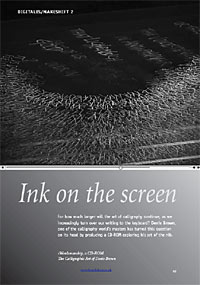
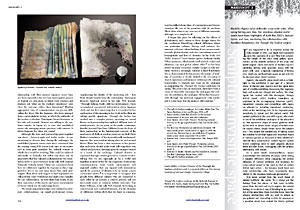 Makeshift’score concerns are even more fully present in FDR7, where the synergy between ancient and modern, hi tech and hand made, is particularly emphasised. The issue contains at least three highlights to the focus on these crossovers: George Dyson and his Aleutian island baidarka boat-building; the recent Anglo-Japanese textiles exhibition, Through the Surface, featuring interviews with textile artists, Machiko Agano and Anniken Amundsen and an overview on the cross-cultural element of the exhibition by curator Lesley Millar; and the relation between contemporary timberbuild, healthcare, computer aided design, complexity science and sustainability in the form of Scotland’s Maggies Centres two newest buildings, the Frank Gehry designed Maggies Dundee and Maggies Highlands in Inverness. Also featured is Irish calligrapher Denis Brown unique CDRom, along with an interview with leading timber engineer, Julius Natterer.

In FDR6 Middleground’s Makeshift subsection Chris Rose reports on a unique dialogue between Maine’s world renowned Haystack school of crafts and MIT’s electronic media hothouse, The Media Lab. Kaffe Matthews tells the story of creating a sonic chair, the movement of which triggers a range of sounds. Representing the disappearing world of and traditional craft the historical making of love tokens and love spoons from Wales to the wider world is documented.
Makeshift in FDR5 includes an essay on groundbreaking Japanese textiles exhibition, Textural Space and an in-depth dialogue between Chris Rose and leading ‘impossible-furniture’ maker Fred Baier. There’s also Indian paper making, using elephant shit and promoted and distributed by the Sussex based Khadi Papers.
 Much else, besides Helena Hietanen’s beautiful Technolace-making is weighted towards craft as much as design. A mix of futurist fiber-optic material and traditional Finnish lace-making forms, along with technolace, Representing Making, Katie Bunnell’s ceramics based CD-ROM work is reviewed, looking both at the increasing significance of new media to the world of pottery. In Make-Do, the occasional series guiding people on how to actually make artefacts, Simon Watts guides the reader on making children’s traditional Portuguese wooden toys. There’s an interview with the basket-maker Lizzie Farey, who creates lovely willow nests, and whose work sits half way between basketry and land and nature art. Lastly within Wordwatch a handwritten piece on Siberian reindeer boots, and the nomadic reindeer herding culture, part of the review of Spirit of Siberia.
From a somewhat different perspective (and in the Wordwatch book reviews section), related to the explorations of the body and its senses, (Blindness, the importance of body movement in Morris Berman’s later work) Infinite Gesture: Whither the Hand, examines whether the hand is a critical and central part of our evolutionary make-up and if so, how living lives without such integration might influence this evolution. From this, the effect of computers within craft, and for the maker, in the use of their hands and the full body is discussed. Two complementary books, Frank Wilson’s The Hand, and Malcolm McCullough’s Abstracting Craft provide the backgound to this exploration.
 FDR2/3 contains four pieces relevant to craft, though mostly turning up independently of a direct craft theme. Land artist Chris Drury is interviewed, appearing in Architexts, (partially as there wasn’t at this time either a craft or arts section) where Drury explains the processes by which he has built some of his structures; including the 1995 Sussex Lewes Castle willow vortex, the air vessels, and a summer covered tumulus. There’s also Luxembourg’s Art Kites Festival, and in the Make-Do sub-section – Andy Wilson from Knock On Wood tongue drum makers provides an easy and accessible guide on making a marimba. Finally in Wordwatchthe varieties of indigenous traditional and craft styles of clothing are discussed, in World Dress, by Frances Kennett.
The earliest issue, FDR1 also includes two craft inflected pieces; first with Marion Brandis on using computer modelling to assist in her ceramic designs, the second on Sussex’s Weald and Downland Museum and its buildings providing a complete database for maintaining knowledge about long disappeared ways of building and ways of life.