margins of music
What kinds of astonishment expresses the ecstasies and strangenesses of this (and other) worlds ? Well, music can and does, beginning where the language of words break up and stutter to a full stop. A vast part of the strangeness of the world is that of the natural, and of nature, both out there and in here. And music and the soundworld does and can summon the surreal realm of the natural in ways which other mediums don't seem to convey. This is where music and Fourth Door begins.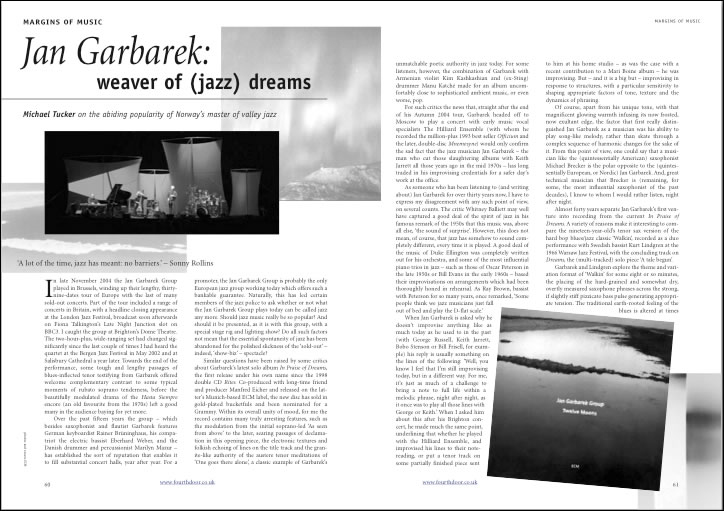 These may be somewhat intense words by which to introduce Fourth Door Reviews music section, Margins of Music (MoM). There again, though music and the environment are increasingly seen as connected, this can be feel superficial and forced. What Fourth Door is doing, through our various editions, is to unearth ways to widen the way of this critical conversation, so that contemporary music is woven into ecological conversations, and similarly, the same is done, looking in from the other way round. This isn't the only threaded weave that Fourth Doors MoM section is about, though it's the most tangible link between two elements to the contemporary world which are considered entirely separate, bar a band supporting Greenpeace in a benefit gig, or there being a solar stage at one of the summer festivals. All interesting developments, and ones we've explored early on (for instance the 1998 piece in Fourth Door Review 2/3 on greening recording studio) though hardly reaching far into the heart of the matter. And though music and nature are primary ingredients, as with all of Fourth Door Review, the aim has been to deepen the conversation across the terrain which Fourth Door has made its own.
  So these extra ingredients - exploring the broader context of the contemporary soundscape while integrating social and environmental dimensions - are part of our scene. And they're complemented with other explorations. Such as, what exactly? Well, music and sounds relation to other media and disciplines - be it music-making as a craft and skill activity; as a part of new media convergences or as music technologies as aspects of the philosophy of technology. At times, as in the recording studio example, we're also very much about overlapping with issues which are broadly green, from practical discussion of how elements of musical practice can take on a greener hue, to the vital provision of discussion of areas such as embodiment and virtuality and globalisation. What we're after are seamless flows between the music world and other subjects. Here, think place, and think, out of place, and think how both music and the built environment connect to place, albeit in different ways. From there, the connection between the apparently different worlds of music and architecture, through place turn visible; a place, perhaps, where architecture melts into music.
 Rarified introductory description over! Thank you very much. From here on in, what follows are brief overviews of the music features during Fourth Door Reviews eight edition life.
In the most recent Fourth Door Review - no 8, there's a rare and extensive interview with David Sylvian, looking at the many elements to his thirty-something career through esoteric and cult popularity. Alongside the Sylvian feature, his colleague Harold Budd, creator of the atomospheric Lovely Music is interviewed and overviewed, making this MoM something of a mini samadhsoud feature.
FDR7 focuses its MoM energies on the master of Nordic atmospherics, and defining voice of the ECM records, Jan Garbarek. The article written in the aftermath of Garbareks 2004 tour and album In Praise of Dreams is by biographer and long time Garbarek aficionado, Michael Tucker.
The focus of Fourth Door Review 6's MoM section is a special themed section on Indian Oceans of Sound; how the south Asian classical traditions compose the ground of an emerging twenty-first century planetary music, pulling the traditional forms of drone, raga and gamelan into the future. Indian Oceans of Sound features in-depth interview features on the cult ambient trumpeter, Jon Hassell; the doyenne of microtonal drone soundworlds Sheila Chandra; and Mark Lockett weaving gamelan orchestra with generative music technology.

In FDR 5 MoM mixes an in depth look at the new Norwegian music scene, with an exploration of how this northerly country is using new technology to create forms of new media which are both geo-physically and place sensitive. The focus in on Norway's far north Tromso techno scene, with Biosphere and bands on the citys Beat Service label. Further to the south Norways own twenty first century ECM record label, Rune Grammofon as well as the cutting edge synergy between organic techno and avant-impro found in Bergen's Supersilent.
FDR4 highlights the changing topographies of music and place and cyberspace, including, a feature on the ISDN concerts of the Future Sound of London (FSOL), an interview with Yat-Kha, the mid Asian Tuvan throat singing punk band, David Rothenberg on ECMs Earthjazz.
Double issue FDR2/3 heads up a special MoM section on Women and Electronic Music "...imagining for a MoMent, a world in reverse, a thousand female electronic bands webbing an ambient firmament of soundscapes", featuring Birmingham analogue miniaturists Pram, Margaret Feidler's Laika, and impro MIDI-Violinist Kaffe Matthews reflect on where both electronic music and its technology could go given a exponential influx of female energy.
FDR1 launched Fourth Doors MoM with interviews with German avant-rock band Cans Holger Czukay on the living qualities of machines; Scottish Highlands singer Talitha MacKenzie and her orginal band Mouth Music. The interviews ranged from the linguistic ecologies of singing in Highland and Islands Gallic to the musics hi tech music backdrop.
 Sound art, and sound installations, until recently another sound-path often less travelled, have also long held our attentions; the mixing of sound into the built environment a natural choice for the review. In FDR2/3 Architexts section the 1996 crossover acoustic ecology installation piece Sound/ Gallery, in Copenhagens Town Hall Sq is overviewed. With the square wired for sound sculpting, sound artists carved aural environments for people to inhabit, move in and traverse. In FDR5 sound art and sculpture returned in the guise of the work of Anna Karyn Rynander and her Gardermoen Airport Sound-Showers which, as with her other installation experiments tint and alter ones everyday, built travelling environment. Within the Biosphere interview, Fluxgate, the quirky snowball activated sound installation that Biosphere and his English compatriot Jony Easterby built in Tromso.
 The developing convergence between the built environment, aspects of new media and technology, and sound sculpting installation, which enable a full bodied participatory experience of sound is a continuing part of Fourth Door Reviews editorial slant.