
For many books can still change lives, and mean so much to people. Wordwatch, Fourth Door Review's book reviews section, bears witness to this by drawing together a review section which respects and honours such a conception of books' continued relevance and place in people's lives. In the main we look at books, which approach life whole, and which are being done, as far as we can tell, for the right reasons. In turn books are reviewed and explored in an authentic, involved way. We’re interested in counter-balancing the prolific popular, commercial and primarily exploitative literature, by finding and giving space to a diverse, serious though less visible arena of writing which is by and large ignored by much of the mainstream media in this country. There are many books published which deserve a degree of attention which the mainstream neither has time nor space for. That said, some reviews may be lengthy and prepared to give space to themes in need of considered reflection. Other reviews however are shorter, and criss-cross disciplines.
 Fourth Door Review 8’s Wordwatch books section turns the pages of three contrasting book sphere’s. First media theorist, Tom De Zengotita, evaluates Morris Berman’s recent opus, Dark Age America, a fierce though politically and intellectually rigorous prophecy of the end of the American Age. This is followed by a special overview of a particular strand of recent cyberpunk sci-fi literature; the mid nineties wave of nanotechnology science-cum-cyber fantasy; including Neal Stephenson’s The Diamond Age; Kathleen Anne Goonan’s, The Nanotech Quartet; and Michael Crichton’s Prey. The final Re-read piece takes another look at Lewis Hyde’s remarkable The Gift, the influential cultural exploration of the varied and different ways in which human exchange and offer what is there’s to others.
There are two books reviewed Fourth Door Review no 6. The first, Touching the Rock by John Hull, movingly outlines the experience of blindness for Hull, an Australian theology lecturer teaching and living in Britain, who in his early adulthood lost his sight, and consequently wrote this extraordinary biography of the experience. In it Hull compellingly records the change of sensory awareness blindness brings with it, and how his experience first forced and then gradually helped him accept another world of the senses, While such experience is not explicitly ecological, it does bring to mind living the full ecology of the senses. The second book in Wordwatch is on Architecture and its future. Susannah Hagan’s book, Taking Shape. Hagan contends an emergent ecological architecture is ‘taking shape’ at the beginning of this new century, just as the modernist architectural impulse did at the outset of the twentieth century. This new impulse in architecture is environmental not only in aspiring to meet sustainable low energy requirements, but also by showing ecological and biological processes within the way buildings work and evolve.
 FDR5 features a fully themed section on issues around the concepts of paradigm change. In a detailed overview of the trilogy of books by Morris Berman, the Re-read essay explores the evolution of his thinking about cultural evolution from his early work, The Reenchantment of the World through to Coming to our Senses, and in 2000, Wandering God. From Berman’s early contention that a shift in consciousness connected to the world of nature is underway, the review explores his increasing misgivings about paradigm change, and with the conclusion of the trilogy, offering the original thesis that a different nomadic and ‘paradoxical’ consciousness does indeed exist, but that this originated in walking, and our feet, rather than myth or transcendence, and it is ‘movement’ which is at the biological heart of this ‘paradoxical’ enchanted state of being. To deepen this discussion of Paradigm change, the philosopher of science, Jerome Ravetz reviews both a biography of the man who inadvertently created the ‘paradigm shift’ catchphrase, Thomas Kuhn, and a recent update by Kuhn himself on his thinking since the publication of The Structure of Scientific Revolutions, the controversial philosophy of science book which originated all the dispute in the first place. To round off the we take a critical look at the movements economic dimension, within a review of New Age Capitalism, by Kimberley Lau.
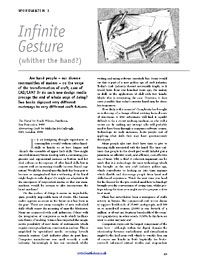
In FDR4 and related to the explorations of the body and its senses - Blindness, and the importance of body movement in Morris Berman’s later work - though from a somewhat different perspective Infinite Gesture – Whither the Hand - examines the history and neurophysiology of the hand. Through Frank Wilson’s The Hand and Malcolm McCullough’s Abstracting Craft the piece asks whether the hand is a critical and central part of our evolutionary make-up and if so, whether living lives without their integration may redirect this evolution. Integrated into this, is a reflection on the effect of computers within craft, and for the maker, in the use of their hands and the full body.
Given the precedence of the hand in this Wordwatch it isn’t completely surprising that there is also a piece which is actually handwritten, on another hand-based skill - Siberian reindeer boots (!), and the nomadic reindeer herding culture it derives from, as part of the review of Spirit of Siberia, by Rick Riewe and Jill Oakes. Also in this edition, Malcolm Learmonth looks at a CD version of the I-Ching, considering the changes brought by making this ancient divination system virtual, and whether the falling of the yarrow stalks are ever the same if scattered inside space.
 Issue 2/3 of Wordwatch includes four book reviews. Reinventing Nature edited by Michael Soules, reviewed by the American environmental philosopher, Michael Zimmerman, looks at how the reach of post modernism can includes the ecological. Carol J Greenhouse's A Moments Notice: on the Anthropology of Time, explores the different cultural apprehension of time, from a postmodern perspective of social agency. And in Re-read the leading Indianologist Richard Lannoy, reassesses his 1973 landmark overview on India, The Speaking Tree. Finally in thisWordwatch the varieties of indigenous traditional and craft styles of clothing are celebrated, as well as looking into their progressive disappearance in the face of individual global styles of clothing codes, in World Dress, by Frances Kennett.