 Whilst Fourth Door began with the aim of addressing serious themes with seriousness it also wanted a counter-balance with lighter, shorter pieces for the time out in our lives could find a place in the overall feel of the review.
The result is a space called Middleground, which generally sits pretty much in the middle of the review, a buffer complement to the other sections. Middleground exists due to a belief that people are multi-faceted creatures, who may be interested Fourth Door for its mind nourishment but are as interested in making a good meal. This comes from a belief that any eco-oriented magazine worth its green salt should support a culture of making and play, rather than serve consumption and passivity.
 So contrasted to the main feature pieces of issue 8 Middleground content mixes the shorter with the positively micro-sized pieces. These include a look at the planets most popular natural clothing material, Indigo, courtesy of revisiting the A Blue to Dye for exhibition; the strange completely binary books of Matt Lumby; an introduction to Mongolia’s music festival with a difference, Roaring Hooves by its founder, Bernhard Wullf; and two woody pieces, one on Helsinki’s cool wood school, Wood Studio, written by Pekka Heikenen, its director, the other looking at the quiet disappearance of the small English sawmill, by carpenter and historian, John Russell. Resident kitchen artist, Kate Dodd offers another of her lovely recipes and there’s also the second in our series of magazines we like and which seem to be off the beaten track, this time, Steppe, a magazine devoted to the near eastern Stan countries. Finally a longer piece by well-known and award winning writer, Jay Griffiths, who explores our different understandings of water, rivers in relation to time.
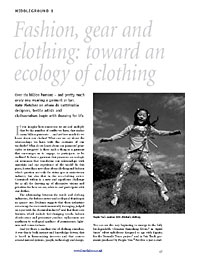
Stepping back to FDR7’s Middleground, Kate Fletcher explores the differences between fashion and clothing from the eco-perspective, a pictorial description of London’s lost rivers; and a look at Irish alternative culture small magazine, The Yoke, as well as a revolutionary Fridge design, FRIA, which halves normal energy use. We take a walk round the Museum of Garden History and there is the ever-present Middleground recipe, this time from Manna from Heaven, in Sydney, Australia.
 FDR6 features the Thai Elephant Orchestra; how the Thai Elephant Conservation Centre managed to get their elephants playing music on giant improvised marimba type instruments. There’s also two eco new media design pieces; the Italian designer, Inci Mutlu’s Wattbug technology, a friendly mechanical bug alerting folk to how much energy their homes are using, and Adam Nieman’s Scale Explorer project, visualising the finite nature of some of worlds critical natural resources in persuasive, understandable ways. There’s the incredible Orange schnozzle cake bake as our recipe tip and a report on a unique dialogue symposium between Maine’s world renowned Haystack school of crafts and MIT’s electronic media hothouse, The MediaLab; while Kaffe Matthews tells the story of creating her sonic chair. Representing the disappearing world of tradition, craft and beauty, is a piece on the historical making of love tokens and love spoons, from Wales to the wider pan European context of this lost tradition.
FDR 5 begins with the groundbreaking Japanese textiles exhibition, Textural Space; an in-depth dialogue between Chris Rise and leading furniture maker Fred Baier. There’s also Sussex based Khadi Papers’s Indian paper made from elephant shit, by Khadi-director, Nigel Macfarlane, while the recipe is courtesy of kitchen ritualist, Miche Fabre Lewin.
 Issue 4 is different again. We focus on the reforestation and return of Soctland’s great Caledonian forest. Katie Bunnell’s CD Rom, Representing Making, representing the crossover of new media and pottery is reviewed, and Simon Watts shows the reader how to make children’s traditional Portuguese wooden toys. There’s a pancake curry recipe as well as permaculture gardening tips from well-known Permaculture authority, Patrick Whitefield. Last though not least is an interview with Lizzie Farey, the maker of beautiful willow art baskets.
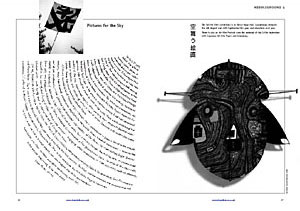
Double issue 2/3 features a history of Brighton's pioneering Infinity Foods; the Luxembourg Art Kites Festival and Knock on tongue drum-makers Knock on Wood’s Andy Wilson on making a marimba. Patrick Whitefield provides Permaculture tips, and there’s a lovely spanakopita recipe.

In FDR 1, Middleground consists of an interview with Marion Brandis, on using computer modelling in her ceramic pottery and a look at Sussex’s Weald and Downland Museum of traditional buildings and Kate Dodd offers us her nut-roast recipe, and in double page spread we showcase artist, Simon English’s Camomile Swan, grown and mowed from a field of camomile.